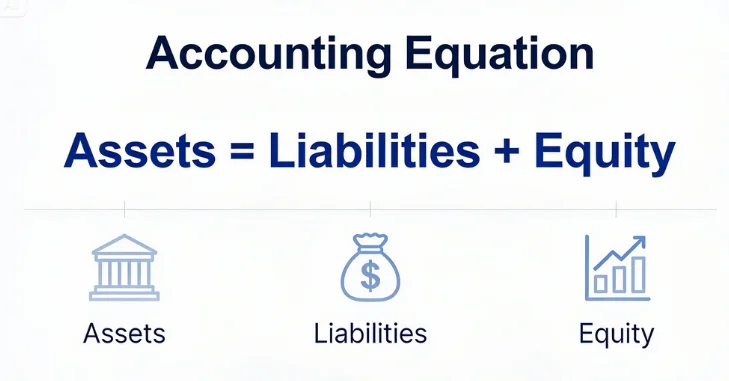
The accounting equation shows how everything a business owns is financed. The basic formula is Assets = Liabilities + Equity. Understanding it makes balance sheets and everyday bookkeeping much easier to read.
| Key point | What it means |
|---|---|
| Basic formula | Assets = Liabilities + Equity |
| Assets | Resources a business owns or controls |
| Liabilities | Amounts the business owes |
| Equity | The owners’ remaining interest |
| Main purpose | Keep financial records mathematically balanced. |
| Used in | Balance sheets and double-entry bookkeeping |
| Rearranged formula | Equity = Assets – Liabilities |
| Expanded form | Assets = Liabilities + Capital + Revenue – Expenses – Draws |
Direct answer: Assets equal liabilities plus equity. Assets show resources the business controls, while liabilities show obligations to outsiders. Equity represents the owners’ residual interest after liabilities. Every properly recorded transaction preserves this relationship, which is why the formula sits behind the balance sheet and double-entry bookkeeping.
Key Takeaways
- Assets must equal the combined total of liabilities and equity.
- Every business transaction changes at least one account.
- Transactions must preserve the balance between both sides.
- Equity represents the owners’ residual claim on business assets.
- Revenue generally increases equity, while expenses reduce it.
- The expanded formula helps explain changes inside the equity section.
- A balanced balance sheet can still contain classification or valuation errors.
What Is the Accounting Equation?
The formula describes the relationship between a company’s resources and the claims against those resources. Assets appear on one side, while liabilities and owners’ interests appear on the other. This structure forms the foundation of the balance sheet.
Another useful approach is to think about sources and uses of money. A business gets assets through borrowing, owner investment, or earnings retained in the company. OpenStax describes the same relationship through resources and claims against those resources.
Understanding Assets, Liabilities, and Equity
Each part of the formula answers a different financial question. Assets show what the company controls, while liabilities identify obligations to other parties. Equity shows what remains for owners after liabilities are deducted.
| Component | Plain-English meaning | Common U.S. business examples |
|---|---|---|
| Assets | Resources owned or controlled | Cash, inventory, equipment, accounts receivable |
| Liabilities | Obligations owed to others | Loans, accounts payable, accrued expenses |
| Equity | Owners’ residual interest | Owner capital, common stock, retained earnings |
Business structure can change the terminology without changing the relationship. Sole proprietorships often use “owner’s equity,” while corporations commonly use “stockholders’ equity.” The underlying financial logic remains the same.
Why the Formula Must Stay Balanced
Every asset has a financing source somewhere in the records. That source can come from creditors, owners, or accumulated business earnings. The balance sheet reflects those sources by placing liabilities and equity against total assets.
Double-entry bookkeeping helps preserve this relationship after every transaction. Each transaction affects at least two accounts or produces offsetting changes within one category. This structure explains why total debits and credits remain equal in properly recorded entries.
Balance does not prove every entry is correct. A bookkeeper could classify equipment incorrectly while recording equal debits and credits. The records would balance mathematically, yet the financial statements could still mislead readers.
Five Small-Business Transaction Examples
Examples make the balance-sheet relationship easier to understand. Assume a new U.S. consulting company begins with no assets or debts. Each transaction below shows how the financial position changes.
| Transaction | Assets | Liabilities | Equity | Result |
|---|---|---|---|---|
| The owner invests $20,000 cash. | +$20,000 | $0 | +$20,000 | $20,000 = $0 + $20,000 |
| The business borrows $10,000. | +$10,000 | +$10,000 | $0 | Both sides rise equally. |
| The business buys $4,000 in equipment for cash. | Cash -$4,000; equipment +$4,000 | $0 | $0 | Total assets stay unchanged. |
| The business earns $3,000 in cash revenue. | +$3,000 | $0 | +$3,000 | Profit increases equity. |
| Business pays a $1,000 expense. | -$1,000 | $0 | -$1,000 | An expense reduces equity. |
The equipment purchase is especially useful because total assets do not change. One asset falls while another asset rises by the same amount. This shows why not every transaction requires changes on both sides of the formula.
Borrowing works differently because the company receives an asset and creates an obligation. Cash increases when loan proceeds arrive, and liabilities increase by the same amount. The loan itself is not business revenue.
The Expanded Accounting Formula
The expanded version breaks equity into the activities that cause it to change. For a sole proprietorship, those activities usually include owner contributions, revenue, expenses, and withdrawals. This version makes the connection between daily activity and ending equity clearer.
Assets = Liabilities + Owner’s Capital + Revenue – Expenses – Owner’s Draws
Revenue increases the ownership interest when the business earns income. Expenses reduce that interest because they consume resources while producing revenue. Owner withdrawals also reduce equity, but they are not normal operating expenses.
This distinction matters for small-business bookkeeping. An owner taking $2,000 from the company does not automatically create a $2,000 business expense. Correct classification helps keep profit reporting separate from distributions to owners.
How to Rearrange the Formula
You can rearrange the relationship when one figure is missing. The same three values remain connected regardless of which amount you need. Simple subtraction is enough to isolate liabilities or equity.
| What you need | Formula | Example |
|---|---|---|
| Assets | Liabilities + Equity | $40,000 + $60,000 = $100,000 |
| Liabilities | Assets – Equity | $100,000 – $60,000 = $40,000 |
| Equity | Assets – Liabilities | $100,000 – $40,000 = $60,000 |
The equity version is especially useful when reading a balance sheet quickly. It shows how much recorded value remains after recognized obligations are deducted. That figure should not be confused with the company’s market value.
Common Errors That Cause Confusion
Most beginner mistakes involve classification rather than arithmetic. Money entering a bank account does not always represent revenue. Money leaving the account does not automatically represent an expense.
| Common mistake | Correct treatment |
|---|---|
| Treating loan proceeds as revenue | Record cash and a liability. |
| Treating owner investment as sales | Record cash and owner equity |
| Treating owner withdrawals as operating expenses | Reduce owner equity |
| Forgetting accounts payable | Record the asset or expense and the liability. |
| Recording financed equipment only as an asset | Record the related debt too. |
| Assuming a balanced statement must be accurate | Review account classification and supporting records. |
Reliable records make these distinctions easier to maintain. InvestBout’s discussion of How Bookkeeping Services Can Save You Time and Money offers related ideas for maintaining dependable business information. Clean source records reduce avoidable bookkeeping problems later.
How the Formula Helps Business Owners
The formula gives owners a quick framework for understanding financial position. Rising assets can mean growth, but the funding source matters equally. Asset growth financed entirely by debt creates a different position from growth funded through retained earnings.
That distinction becomes important during financing decisions. InvestBout’s guide to Ava Wood discusses financial questions businesses should consider before seeking outside funding. Owners can use balance-sheet information alongside cash flow and repayment capacity.
Equity information also becomes relevant when ownership capital changes. Businesses considering outside investors can review InvestBout’s explanation of How AquaDoc Became a Pool Powerhouse in 3 Years.
What This Formula Cannot Tell You
A balanced balance sheet does not prove a company is profitable. A business can own substantial assets while producing losses or struggling to pay short-term bills. You still need income and cash-flow information for a fuller financial picture.
The formula also does not calculate the market value of a company. Book equity comes from recorded accounting amounts, while market values reflect different information and expectations. Investors therefore use the relationship as a starting point rather than a complete valuation method.
Financial statements also cannot replace business strategy. A company needs goals, budgets, operating plans, and informed decisions alongside accurate records. InvestBout’s guide to creating Beverage Packaging: Building Efficiency and Brand Value explains how long-term direction can guide those wider choices.
Frequently Asked Questions
Why is the accounting equation important?
It provides the structure behind every balance sheet. It also helps explain how business transactions affect assets, debts, and ownership value. Bookkeepers use the same relationship when maintaining double-entry records.
What happens if assets do not equal liabilities plus equity?
An imbalance usually signals an error in the records or financial statement preparation. One side of a transaction may be missing or entered incorrectly. The underlying entries should be reviewed before relying on the statement.
Can a business have negative equity?
Yes, recorded equity can become negative in some situations. This happens when liabilities exceed assets under the amounts shown on the balance sheet. Persistent losses and accumulated obligations can contribute to that position.
Does every transaction affect assets, liabilities, and equity?
No, one transaction does not need to change all three categories. Buying equipment with cash changes two asset accounts without changing total liabilities or equity. Borrowing money increases both assets and liabilities.
Is the formula the same for corporations and sole proprietorships?
The basic relationship remains the same across common business structures. The main difference is the terminology used inside the equity section. Corporations usually refer to stockholders’ or shareholders’ equity instead of owner’s equity.
Put the Formula to Work
Start with your latest balance sheet and confirm that total assets match liabilities plus equity. Then review major transactions and identify which accounts each transaction changed. This simple exercise builds a stronger understanding of how your financial statements connect.
The formula becomes more useful when you stop treating it as something to memorize. Use it to trace borrowing, owner investments, purchases, revenue, expenses, and withdrawals through your books. That habit can make financial reports easier to review and discuss.