A car wash franchise can range from a mobile operation to a multimillion-dollar tunnel business. Your capital, market, and preferred operating style should determine which model deserves closer review. The franchise name alone should never drive an investment decision.
| Key factor | What U.S. investors should know |
| Entry cost | Mobile models can start near six figures, while large tunnel concepts require much more capital |
| Main formats | Mobile detailing, commercial fleet washing, and automated tunnel washing |
| Major costs | Franchise fees, equipment, property, construction, payroll, working capital, royalties, and marketing |
| Key document | The current Franchise Disclosure Document, or FDD |
| Financing | Owner equity, conventional loans, and eligible SBA-backed financing may be considered |
| Main risk | Strong sales do not automatically produce strong owner profits |
| Best first step | Compare current FDD figures and speak with existing franchisees |
A U.S. franchise in this sector can cost from roughly $100,000 for a mobile detailing model to several million dollars. Your real budget depends on property, equipment, working capital, royalties, and financing. Compare the current FDD before treating any advertised investment range as final.
How Much Does a Car Wash Franchise Cost?
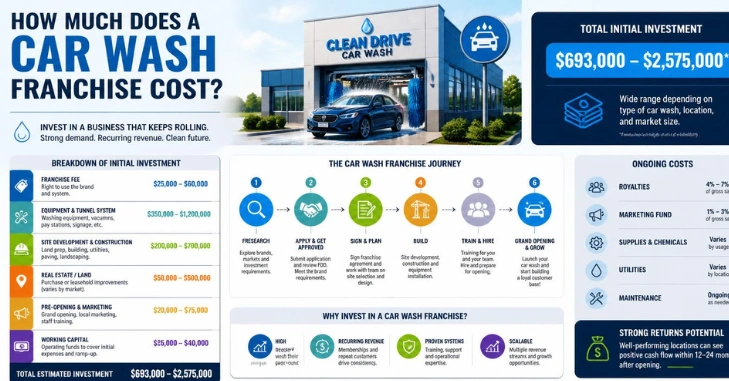
Car wash franchise startup costs vary widely because the underlying business models differ. Mobile operators avoid the construction costs associated with a permanent tunnel facility. Large express sites can require substantial property development, utility, and development spending.
DetailXPerts currently lists an estimated initial investment of $103,500 to $240,100. Its published breakdown includes a $35,000 initial franchise fee and a $15,000 vehicle-using unit. Other expenses include inventory, software, marketing, insurance, training, and working capital.
Fleet Clean sits higher on the capital scale for its commercial fleet-washing model. Its 2026 FDD data shows an estimated initial investment around $188,350 to $459,000 for the standard format. The same filing data lists a $10,000 initial fee and an 8.5% ongoing royalty.
Large tunnel operations demand a different financial profile. Tommy’s Express lists liquid-asset requirements between $500,000 and $2 million, depending on the format. Its published requirements also show net-worth thresholds between $2 million and $5 million.
CompareTommy’sTommy’sU.S. Franchise Models
The strongest choice depends on how much capital you can commit safely. It also depends on whether you prefer consumer, fleet, or location-based operations. These three examples show how different the category can become.
| Franchise example | Operating model | Published financial information | Main advantages | Main tradeoffs |
| DetailXPerts | Mobile detailing and cleaning | $103,500–$240,100 estimated investment; $35,000 initial fee | Lower entry cost; mobile operations; several service lines | Requires service execution, staffing, and local customer acquisition |
| Fleet Clean | Mobile commercial fleet washing | About $188,350–$459,000 estimated investment; $10,000 initial fee | B2B focus; recurring fleet relationships; avoids consumer tunnel property | Commercial sales matter heavily; 8.5% royalty affects margins |
| Tommy’s Express | Automated express tunnel | $50,000 initial fee; substantial liquidity and net-worth requirements | High-throughput model; established systems; membership potential | Significant capital needs; construction risk |
DetailXPerts fits investors seeking a lower-capital mobile model more closely. Fleet Clean fits owners comfortable building commercial accounts and managing route-based services. Tommy’s Express fits investors with considerably greater liquidity and development capacity.
DetailXPerts
DetailXPerts uses mobile steam cleaning across automotive, fleet, and commercial services. That structure reduces dependence on a single fixed wash tunnel and traffic corridor. It also creates more responsibility for scheduling, staffing, and local business development.
The published investment range makes this model more accessible as a single large express facility. Yet a smaller upfront check does not guarantee stronger returns. Labor efficiency, repeat customers, route density, and local pricing still shape the economics.
Fleet Clean
Fleet Clean focuses on on-site washing for commercial vehicle fleets. Its official site describes both traditional franchising and a separate manage-to-own pathway. That business model can appeal to owners who prefer contracted commercial relationships.
Fleet work can create recurring revenue when customers operate vehicles continuously. Still, winning and retaining commercial accounts requires dependable service and disciplined sales work. Investors should examine customer concentration before relying on large contracts.
Tommy’s Express
Tommy’s Express uses an express tunnel format designed for substantial vehicle throughput. The franchisor currently charges a $50,000 initial fee, plus a 4% royalty. It also requires a 1% contribution to Tommy’s All Brand Fund.
This format demands more than enough money to cover the franchise fee. Real estate quality, traffic patterns, construction, utilities, and financing can dramatically change project economics. Investors should model the entire development project rather than focusing on the franchise fee.
What Drives Startup and Operating Costs?
Real estate often creates the largest difference between mobile and tunnel businesses. A fixed facility may need land, major construction, specialized equipment, drainage, utilities, signage, and permitting. A mobile operator replaces much of that spending with vehicles, equipment, routing, and field labor.
Working capital matters after opening, too. Payroll, chemicals, utilities, insurance, repairs, advertising, debt payments, and royalties continue regardless of weekly traffic. Your budget should therefore include enough cash for a slower-than-expected ramp.
Recurring fees deserve separate analysis because they continue after opening. A modest initial fee can coexist with meaningful royalties and required marketing contributions. Model those charges at several realistic sales levels before signing an agreement.
Revenue and Profit Are Not the Same Number
A successful wash business needs enough volume to cover both fixed and variable costs. Membership programs can improve recurring revenue for tunnel operators when customer retention remains strong. Commercial contracts can provide similar repeat demand for fleet-focused operators.
Revenue figures should never be read as owner income. Debt service, payroll, repairs, utilities, rent, royalties, and advertising must still be paid. A high-volume operation can produce disappointing returns if its cost structure is too heavy.
Review Item 19: Operators must still pay debt; check current FDD when financial performance information is provided. Review the compilation, exclusions, operating periods, and measurement method. Then ask current owners whether your assumptions resemble their real operating experience.
Financing a U.S. Wash Business
Some buyers combine personal equity with commercial or SBA-backed financing. The SBA maintains a Franchise Directory used for financing eligibility reviews. Placement in that directory does not represent an SBA endorsement or a promise of business success.
Prepare a complete funding plan before contacting lenders. InvestBout’s guide to raising capital explains why owners should calculate funding needs before borrowing. Your projections should include acquisition costs, opening expenses, operating reserves, and debt service.
A lender will also want evidence that your assumptions are supportable. The SBA says lenders commonly consider business plans, funding uses, credit history, projections, and repayment ability. Building those numbers early can flag an unattractive project before you commit money.
Seven Due-Diligence Checks Before You Sign
- Rules of Sources: FDD. Confirm the issue date and review all applicable amendments before relying on older online figures.
- Study Items 5 through 7. Compare initial fees, ongoing charges, and the franchisor’s estimated startup investment.
- Review Item 19 carefully. Understand which outlets produced any reported sales or performance figures.
- Call current and former owners. Ask about construction overruns, franchisor support, marketing, and unexpected operating costs.
- Build a local market model. Estimate traffic, competitors, pricing, customer frequency, wages, utilities, and realistic membership penetration.
- Review the territory terms. Determine whether the agreement limits competing franchised or company-owned locations nearby.
- Use independent advisers. Have a qualified franchise attorney and accountant review the legal and financial commitments.
Federal rules give prospective franchisees important disclosure protections. The FTC’s guide to buying a franchise says franchisors must provide the FDD at least 14 days before signing or payment. The document contains 23 required disclosure items covering material aspects of the franchise offer.
Your operating company also needs the correct legal structure and registrations. InvestBout’s U.S. business entity guide covers common entity and compliance steps. Franchise counsel should still review requirements for your specific state.
Franchise Ownership vs. Starting Independently
InvestBout’s franchise trades some control for an established operating system. Starting independently gives you more freedom over branding, suppliers, services, and pricing. Neither structure removes the need for sound site selection and financial management.
| Factor | Franchise model | Independent model |
| Brand | Existing brand system | Build your own |
| Operating procedures | Defined by franchisor | Created by owner |
| Fees | Initial and continuing fees may apply | No franchise royalties |
| Supplier flexibility | May be restricted | Usually greater |
| Training | Often included | Owner must develop or buy it |
| Control | Lower | Higher |
| Due diligence | FDD plus local economics | Local economics and startup planning |
A franchise can reduce some trial and error during setup. It cannot remove market, financing, staffing, or execution risk. Compare the value of franchisor support against every recurring fee and contractual restriction.
Which Model Fits Which Investor?
A mobile detailing concept deserves attention when your available capital is closer to the low six figures. A commercial fleet model may suit owners comfortable with business-to-business selling. A tunnel format requires deeper capital resources and stronger real-estate development skills.
Choosing a car wash franchise should therefore start with your financial limits rather than brand popularity. Set a maximum equity contribution before comparing opportunities. Keep enough personal liquidity outside the business for unexpected delays.
The best-fit model is the one that survives conservative assumptions. Test lower sales, higher payroll, increased borrowing costs, and slower customer growth. A project that only works under ideal assumptions deserves much more scrutiny.
Make the Investment Decision From the Numbers
Start by deciding whether you want mobile, commercial fleet, or fixed-site operations. Next, request current disclosure documents and build conservative financial projections for your target market. Treat franchisor marketing as a starting point, not your final investment case.
InvestBout’s broader small-business resources can support the planning process as you evaluate ownership. Keep financing, legal structure, staffing, and working capital in the same financial model. A disciplined comparison can prevent an attractive concept from becoming an expensive mismatch.
Before committing funds, speak with existing operators and professional advisers. Ask the franchisor for the latest FDD and every applicable amendment. Invest only after the economics still work under conservative assumptions.
Frequently Asked Questions
Is a car wash franchise profitable?
It can be profitable, but no franchise structure guarantees a profit. Revenue must cover labor, property, utilities, maintenance, debt, royalties, and other operating expenses. Review current FDD data and build a location-specific financial model before investing.
How much money do I need to open one?
The required amount depends primarily on the operating model. Current mobile and fleet examples can require roughly $100,000 to several hundred thousand dollars. Large express tunnel projects can demand substantially greater liquidity and net worth.
Can an SBA loan finance a franchise purchase?
Eligible franchise businesses may qualify for SBA-backed financing through participating lenders. The relevant brand should be checked against the current SBA Franchise Directory. Directory inclusion confirms eligibility review rather than investment quality.
What should I examine first in the FDD?
Start by reviewing costs, ongoing provisions, litigation, outlet changes, and any financial performance representations. Then compare those disclosures with conversations involving current and former franchisees. An attorney experienced in franchising can help identify obligations that are easy to overlook.