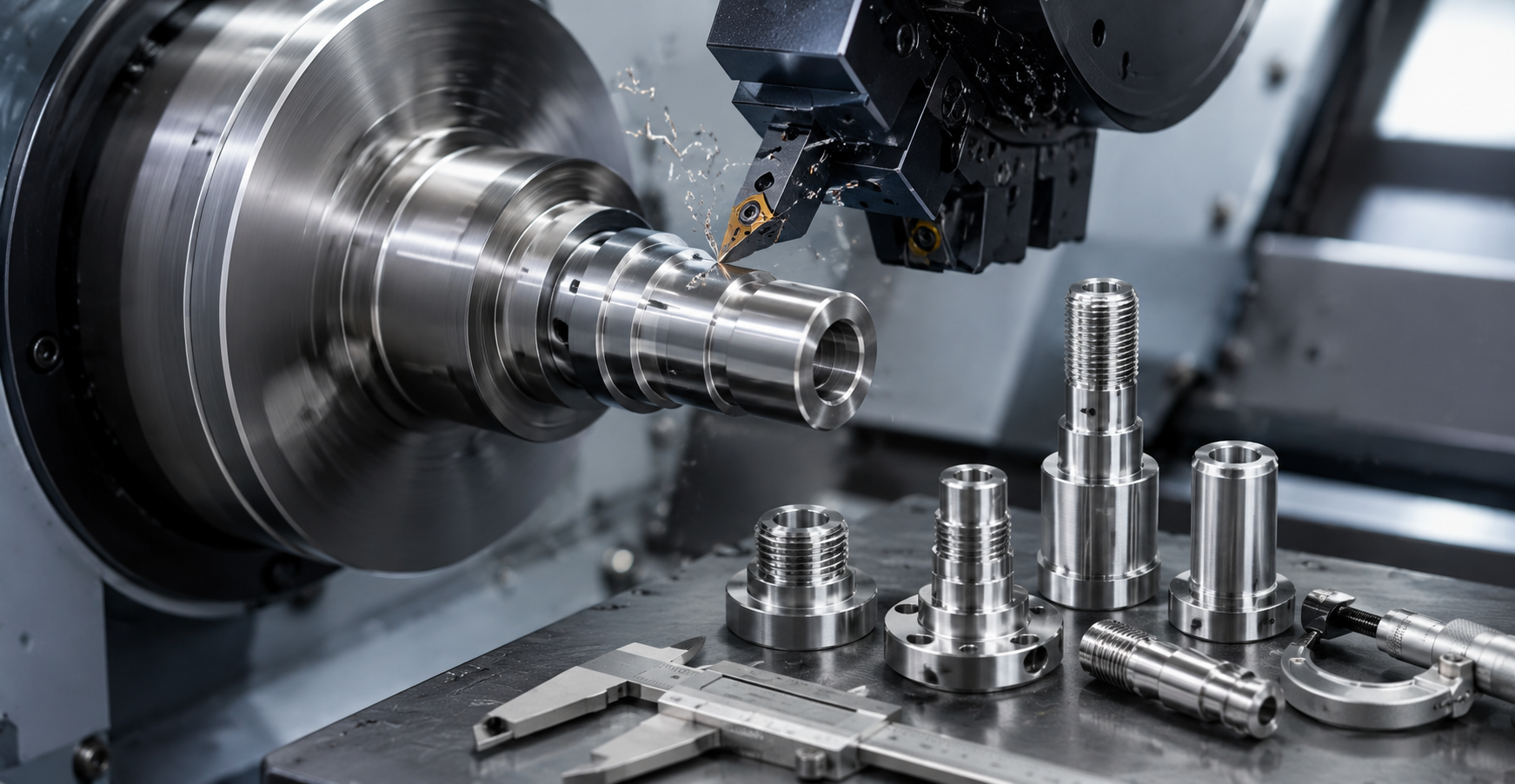
A low unit price can become an expensive production decision when it excludes process risk. For precision turned parts, the real cost extends beyond material and machine time. It also includes repeated handling, late-stage scrap, inspection effort, unstable lead times, excess inventory, and the administrative burden of correcting inconsistent batches. These factors matter most when a prototype moves into recurring or high-volume demand. At that point, procurement teams are not simply buying components; they are buying dependable capacity. A useful sourcing decision must therefore examine how the part will be made, controlled, measured, replenished, and protected throughout its production life. The seven variables below provide a commercial framework for comparing suppliers without allowing the lowest quoted price to obscure a higher total cost.
Why Unit Price Reveals Only Part of the Manufacturing Cost
A quotation reflects material, cycle time, tooling, secondary processes, inspection, packaging, and margin—but it is based on assumptions. If they do not match the drawing or order pattern, the apparent saving may disappear.
The commercial relationship can be expressed simply:
True production cost = quoted part cost + quality loss + inventory cost + delay exposure + supplier management cost
Similar prices can represent different risks. A supplier that plans the complete process may appear more expensive than one excluding difficult deburring, special inspection, or capacity protection. The second quotation may simply be incomplete.
For precision CNC turned parts, buyers should compare the process assumptions behind each price before negotiating the final number.
Variable One—How Many Times Must the Part Be Handled?
Every setup, transfer, and external operation introduces cost and another opportunity for datum shift, damage, mixing, waiting, or operator variation. These risks increase on precision turned parts with short gripping lands or thin walls.
One-Setup Production Changes More Than Cycle Time
A suitable turning platform may combine main-spindle work, backworking, drilling, threading, and limited milling in one cycle. Beyond reducing labour, it preserves relationships between diameters, shoulders, holes, and threads.
Engineers evaluating complex Swiss turned parts should ask which features remain in one setup and which leave the machine for another operation. The answer influences batch consistency as much as direct cost. Properly planned Swiss-turned component production can be especially useful when small diameters, multiple feature directions, and repeat orders make manual transfers difficult to control.
Variable Two—Cycle Time Must Include Its Hidden Interruptions
The displayed cutting cycle is not completed output. Production time also includes loading, bar changes, tool offsets, inspection, maintenance, and movement between departments.
A Fast-Cutting Cycle Can Still Create Slow Output
One route may cut quickly but require two external operations. Another may have a longer machine cycle but complete all important features before discharge. Waiting, transport, inspection, and work-in-progress can make the apparently faster route slower overall.
When reviewing CNC turning costs, procurement teams should ask for the complete process flow rather than one machine-cycle figure. The most useful question is not “How quickly does the tool cut?” but “How long does it take a conforming part to move from material to packed product?”
Variable Three—Scrap Cost Rises with Every Completed Operation
A rejected blank loses material. Rejection after turning, drilling, deburring, cleaning, and inspection loses the value accumulated at every step. Late-stage failure is therefore more expensive.
Protecting the Most Expensive Features Early
Process planning should identify features with high technical or financial risk, including:
- Deep or small-diameter holes with limited chip evacuation.、
- Thin walls that may distort after material removal.
- Diameters and shoulders requiring a controlled relationship.
- Small threads that are difficult to inspect or repair.
- Intersecting holes where hidden burrs can remain.
- Critical surfaces that cannot be corrected after finishing.
These characteristics deserve early verification and defined tool-change rules. Waiting for final inspection to discover drift converts a manageable process adjustment into a batch-level loss. Effective machining scrap rate control depends on detecting movement while parts are still being produced.
Variable Four—Inspection Time Can Become a Production Bottleneck
Inspection is also a capacity variable. If production outpaces measurement of a critical characteristic, inspection can constrain total output.
Measure the Functional Chain, Not Every Feature Equally
Inspection resources should follow the way the part works. A practical priority is:
- Features controlling fit, sealing, motion, or electrical contact.
- Datum relationships locating those features.
- Dimensions used to detect process movement.
- General geometry and non-functional surfaces.
- Appearance requirements.
The method must suit the component. Probes may not reach narrow recesses, contact can distort thin walls, and burrs can affect optical edges. A long report has little value without reliable evidence about assembly performance.
For recurring small precision components, the inspection plan should be developed with the machining route rather than added after samples are complete.
Variable Five—Batch Consistency Has a Financial Value
Consistent precision turned parts simplify incoming inspection, reduce assembly adjustments and troubleshooting, and support more predictable scheduling.
One accepted sample batch does not prove sustained capability. Buyers should confirm that material control, tooling, datum logic, measurement, and handling will remain stable across later orders.
This is why batch consistency has a financial value even when it does not appear as a separate line on a purchase order. Stable production lowers the hidden transaction cost of managing the supplier.
Variable Six—Capacity Must Be Verified Before Demand Increases
Prototype success answers one question: can the part be made? A volume programme introduces a different question: can conforming parts be delivered repeatedly without weakening control elsewhere?
Questions That Reveal Real Production Capacity
Machine quantity alone cannot answer that question. Procurement teams should ask:
- Does the process depend on one machine or one operator?
- How are critical tools replenished and tool life monitored?
- Will higher quantities require a different routing?
- Can inspection capacity increase with machining output?
- How are maintenance and unplanned downtime handled?
- Can packaging and logistics support the required release schedule?
- How will the supplier communicate a capacity constraint?
When assessing high-volume CNC machining capacity, buyers should examine production equipment, process control, inspection, staffing, and delivery as one connected system. This gives supplier capacity planning more substance than an equipment list.
Variable Seven—Inventory Can Hide an Unstable Process
Safety stock protects against interruptions but can hide irregular lead times, variable quality, or insufficient capacity. The business pays through tied-up cash, storage, handling, and obsolete material after revisions.
Stable Production Can Be More Valuable Than Maximum Speed
A supplier that occasionally delivers very quickly but frequently changes its promised date may create more risk than one operating to a dependable replenishment schedule. For high-volume component production, predictable releases support better inventory decisions and reduce emergency freight or last-minute rescheduling.
The goal is to understand why inventory exists. A planned demand buffer differs from stock accumulated because the process cannot be trusted—an important distinction in any total cost of ownership review.
A Commercial Review Checklist Before Awarding a Volume Order
Before approving a long-term order for precision turned parts, engineering and procurement teams should confirm:
- Which critical features can be completed in one setup?
- Does the quotation include every secondary operation?
- How are tool wear and dimensional drift monitored?
- At which stage is scrap most likely to occur?
- Could inspection limit production output?
- How will consistency be verified across separate batches?
- Will higher demand change the approved manufacturing route?
- Does the process rely on a single machine, person, or external supplier?
- Can packaging prevent contact damage, contamination, and mixed parts?
- How are process changes, delays, and quality exceptions communicated?
A capable precision parts supplier should be able to explain these points in relation to the drawing. Generic claims about accuracy or advanced machinery are not a substitute for a documented production strategy.
The Best Production Decision Balances Price, Control, and Continuity
The lowest quotation is useful only when its assumptions support the required quality, quantity, and delivery pattern. For precision turned parts, handling steps, total process time, late-stage scrap, inspection capacity, batch consistency, production resilience, and inventory exposure can outweigh a small difference in unit price. Engineering should define the features that control function, while procurement evaluates whether the supplier can maintain them through recurring production. To support a meaningful manufacturing review, provide a 2D drawing, 3D model, material specification, order quantity, forecast demand, and the component’s role in the assembly. With that context, the supplier can propose a process built around total production value rather than a headline price that may not survive the realities of volume manufacturing.